DCW DAILY BRIEF-Global Digital Assets, ScienceTech & Web3 Market Intelligence

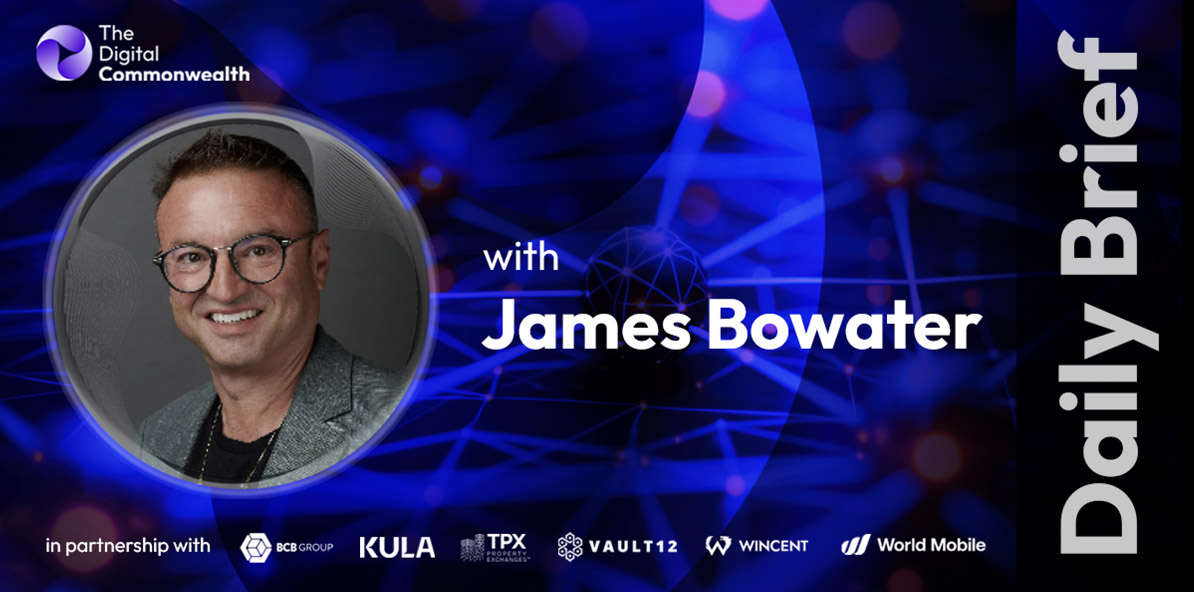
DCW DAILY BRIEF
Global Digital Assets, ScienceTech & Web3 Market Intelligence
Date: March 19th, 2026 │ Thursday Edition #417
In partnership with BCB Group | Kula | TPX property Exchanges | Vault12 | Wincent | World Mobile
James Bowater
linkedin.com/in/james-bowater-b47612 | Twitter/X: X.com@TheDCW_JB
https://www.thedigitalcommonwealth.com/

Next Event: https://www.thedigitalcommonwealth.com/
📊 EXECUTIVE SUMMARY
Markets open Thursday, March 19th, 2026, Iran War Day 19, with a sharp deterioration in the geopolitical backdrop following Iran’s overnight strikes on energy infrastructure across Qatar, the UAE, and Saudi Arabia. Japan’s Nikkei 225 plunged 3.4% to 53,372.53 as the Bank of Japan held its policy rate at 0.75%, while oil prices surged to $113.52/bbl for Brent (up 5.5%) and US natural gas futures spiked 3.3% on fears of a prolonged supply disruption across the Gulf region. Asian markets broadly retreated as investors priced in stagflation risk following both the Fed’s hawkish hold and the overnight escalation in energy infrastructure.
Iran’s overnight strikes across Gulf energy infrastructure mark a decisive escalation. Attacks set Qatari LNG facilities ablaze, forced the UAE to shut down a gas operation, and prompted Saudi Arabia to intercept drone strikes on its eastern region gas facilities and evacuate staff from assets now on Iran’s target list. The strikes came in direct retaliation for Israel’s attack on Iran’s South Pars gasfield, the world’s largest, and signal a shift from maritime disruption toward direct targeting of the Gulf’s core energy production infrastructure. Only a handful of ships, mostly Indian, Pakistani, and Chinese-flagged vessels, have transited Hormuz each day since the war began 20 days ago.
US equities closed sharply lower on Wednesday following the Fed’s hawkish hold and a hot PPI print. The S&P 500 closed at 6,624.70 (−1.36%), the Dow at 46,225.15 (−1.63%, −768 points), and the Nasdaq at 22,152.42 (−1.46%) as the FOMC voted 11-1 to hold at 3.50–3.75%; the sole dissenter, Governor Miran, favoured a cut. February PPI surged 0.7% month-over-month (vs 0.3% consensus), with core PPI rising to 3.9% year-on-year, the highest in over a year. VIX rose from Wednesday’s earlier levels. The Dow closed at its lowest since November 2025 and is now on pace for its worst month since 2022.
The Fed’s dot plot retained only one cut for 2026, a ‘cautiously hawkish’ outcome that disappointed markets hoping for two. Chair Powell’s press conference acknowledged GDP growth of 2.4% but warned the ‘last mile’ of inflation is proving difficult, with energy-driven inflation from the oil shock and 15% global tariffs compounding. Powell confirmed he would serve as Chair pro tem if successor Kevin Warsh is not confirmed by May 23rd. Markets now price a 99%+ probability of a hold at the April FOMC, with traders pushing rate-cut expectations toward late 2026 at best.
Brent crude surged to $113.52/bbl on Thursday morning (up 5.5% from the prior session), extending beyond the $110 barrier on Iran’s strikes on Gulf production infrastructure. WTI also advanced sharply. US natural gas futures (Henry Hub) gained 3.3%. Goldman Sachs’ $130/bbl tail-risk scenario is now firmly in view if Iran directly strikes Kharg Island’s production infrastructure. Gold retreated toward the $4,860–$5,014/oz range as the dollar strengthened for the first time in four sessions on the hawkish Fed stance, offsetting some of the safe-haven demand from the escalation.
Bitcoin fell to \~$71,000 post-FOMC, as the Fed’s hawkish-hold triggered the ‘sell-the-news’ pattern documented after 7 of 8 FOMC meetings in 2025. Ethereum dropped to \~$2,172 (−6.1%), XRP to \~$1.46 (−3.5%), SOL to \~$89.67 (−4.6%), and DOGE to \~$0.09 (−4.9%). The total crypto market cap contracted from \~$2.62T to \~$2.45T as the FOMC-triggered risk-off compounded Iran’s energy escalation. The BTC 48-hour post-FOMC dip window (March 19–20) is now live; the $68,000–70,000 support band is the critical level to hold.
The dominant Thursday narrative centres on five intersecting themes: (1) Iran War Day 19 Energy Escalation: strikes on Qatar LNG, UAE gas operations, and Saudi eastern facilities; Brent surging to $113+/bbl; Goldman $130 tail-risk live; (2) Hawkish Fed Aftermath: S&P 500 −1.36% to 6,624.70; Dow −1.63%; dot plot retains one 2026 cut; PPI +0.7% shock; (3) BoJ holds at 0.75%: Nikkei −3.4% to 53,372.53; yen at ¥160/USD under severe import inflation pressure; (4) BoE and ECB both decide today: BoE expected hold at 3.75%; ECB hawkish hold with elevated inflation language; (5) Crypto post-FOMC correction: BTC \~$71,000; ETH \~$2,172; $68,000–70,000 support band now the critical technical floor; Strategy’s record $1.57B BTC purchase (761,068 BTC total) provides structural institutional floor.
Iran War Day 19: Strikes on Qatar LNG, UAE gas infrastructure, Saudi eastern facilities; Brent surging to $113.52/bbl (+5.5%); WTI also sharply higher; natural gas (Henry Hub) +3.3%; Goldman $130/bbl tail-risk scenario now firmly in play. Japan’s Nikkei plunged 3.4% to 53,372.53; KOSPI tumbled ~3%; Asian markets broadly lower. BoJ held at 0.75%.
Oil: Brent surging to $113.52/bbl (+5.5%) on Iran’s strikes on Gulf LNG and gas infrastructure; WTI up sharply; Henry Hub natural gas +3.3%; IEA strategic reserve release ongoing but inadequate to offset escalation. Gold is pulling back toward the $4,860–$5,014/oz range as the dollar strengthens on a hawkish Fed. 10-year Treasury yield rising; dollar gaining vs yen and euro.
Wednesday US close: S&P 500 6,624.70 (−1.36%); Dow 46,225.15 (−1.63%, −768 pts); Nasdaq 22,152.42 (−1.46%); VIX rising; Dow at lowest since November 2025, on pace for worst month since 2022. Fed hawkish-hold at 3.50–3.75% (11-1); dot plot: one 2026 cut retained; PPI +0.7% MoM shock (vs 0.3% expected); Powell hawkish on energy-driven inflation. The BoE and the ECB both decide today.
Bitcoin \~$71,000 (FOMC ‘sell-the-news’ pattern; 48-hour dip window March 19–20; $68,000–70,000 critical support band); ETH \~$2,172 (−6.1%); XRP \~$1.46 (−3.5%); SOL \~$89.67 (−4.6%); DOGE \~$0.09 (−4.9%). Total market cap \~$2.45T; BTC dominance ~58.5%; Fear & Greed retreating from Neutral toward Fear zone. Crypto ETF outflows expected post-FOMC; Strategy records a $1.57B BTC purchase (22,337 BTC; total 761,068 BTC), providing an institutional floor.
FTX $2.2B creditor distribution confirmed for March 31; Visa CLI launches for AI agent payments; UK lawmakers demand crypto political donation ban (Treasury Select Committee & APPG); FTX total creditor recovery now ~$10B. BoJ held at 0.75%, citing uncertainty over the war in Iran. BoE expected to hold at 3.75%; ECB hawkish hold today.
📰 TODAY’S HEADLINES
💹 MARKETS
- US equity markets closed sharply lower on Wednesday, breaking the two-day winning streak: S&P 500 6,624.70 (−1.36%); Dow 46,225.15 (−1.63%, −768 pts); Nasdaq 22,152.42 (−1.46%); VIX rose sharply, with over 75.5% of US issues declining; the Dow closed at its lowest level since November 2025 and is on pace for its worst month since 2022; all major indexes fell over 1%; Lululemon gained \~5% on a board shakeup and earnings beat; Nvidia saw early gains on H200 China approvals before succumbing to the broader selloff; Micron slid 5% in extended trading despite a quarterly revenue jump; DocuSign gained 1.3% after hours on strong guidance; Disney named Josh D’Amaro as new CEO succeeding Bob Iger.
- Asian markets plunged on Thursday morning following the FOMC hawkish-hold and Iran’s overnight strikes on Gulf energy infrastructure: the Nikkei 225 fell 3.4% to 53,372.53 and the KOSPI tumbled \~3% as investors priced in the compounded shock of a structurally higher US rate path and a new escalation phase in energy infrastructure targeting; the yen remained near ¥160/USD under extreme import inflation pressure; Japan and South Korea depend on imported fossil fuels for 80–90% of their energy needs; regional energy-importing economies (India, Taiwan, Vietnam) also retreated sharply.
- Brent crude surged to $113.52/bbl on Thursday morning (+5.5% from Wednesday) after Iran’s overnight strikes set Qatari LNG facilities ablaze and forced the UAE to shut down a gas operation; Saudi Arabia intercepted drone strikes on its eastern gas facilities; US benchmark WTI also advanced sharply; Henry Hub natural gas futures gained 3.3%; the structural Hormuz 20mb/d disruption persists; Goldman’s $130/bbl tail-risk scenario is now firmly in view if Kharg Island production infrastructure is directly struck; IEA 400Mb strategic reserve release continues but is widely viewed as insufficient against the escalation trajectory.
⚖️ REGULATORY & POLICY
- Iran War Day 19: Iran struck energy infrastructure across Qatar, the UAE, and Saudi Arabia overnight, including setting Qatari LNG facilities ablaze and forcing UAE gas operations offline; Saudi Arabia intercepted drone strikes on eastern gas facilities and evacuated staff from assets on Iran’s target list; the strikes came in direct retaliation for Israel’s attack on Iran’s South Pars gasfield, the world’s largest; UKMTO maintains maritime threat at critical; oil prices surged sharply beyond $110/bbl; the dual-track nature of Tehran’s strategy is now escalating beyond selective maritime disruption to direct targeting of Gulf production infrastructure; US gas prices nationally pushing above $4.00/gallon from the existing $3.79/gallon level.
- The Federal Reserve FOMC voted 11-1 on Wednesday to hold the federal funds rate at 3.50–3.75%; the sole dissent came from Governor Stephen Miran, who favoured a rate cut; the updated dot plot retained only one quarter-point cut for 2026, a hawkish-leaning outcome that disappointed markets hoping for a path to two cuts; February PPI surged 0.7% month-over-month (vs 0.3% consensus), with core PPI rising to 3.9% YoY, the highest in over a year; Chair Powell warned the ‘last mile’ of inflation remains difficult, citing energy-driven price pressures and structural tariff inflation; Powell confirmed he will serve as Chair pro-tem if Kevin Warsh (his leading successor candidate) is not confirmed by May 23rd; the Fed next meets in April.
- The Bank of Japan held its benchmark policy rate at 0.75% on Thursday, citing the ongoing Iran war as a key factor in its decision; the BoJ faces its sharpest dilemma in years: the yen near ¥160/USD and import inflation at crisis levels argue for tightening, but global risk-off uncertainty from the oil shock and FOMC hawkishness argue for caution; the Nikkei fell 3.4% to 53,372.53 in response; economists forecast the BoJ may be forced to act at its next meeting if yen weakness and import inflation continue to accelerate.
- The Bank of England is deciding today (March 19) with consensus expecting a hold at 3.75%; the UK economy presents a challenging mix of oil-driven inflation risk and weak growth; MPC members are expected to flag elevated energy costs as a persistent upside risk to the UK inflation outlook; the ECB is also deciding today and is expected to hold with a hawkish tone, emphasising vigilance on energy-driven inflation and readiness to act if needed; markets are pricing in nearly two quarter-point ECB rate hikes this year reflecting energy shock persistence concerns.
- UK lawmakers from the Treasury Select Committee and the All-Party Parliamentary Group on Crypto and Digital Assets issued an urgent directive calling for an immediate ban on cryptocurrency donations to political parties, following reports that decentralised assets are being used to bypass transparency requirements under the Political Parties, Elections and Referendums Act; the primary concern is the ‘transparency deficit’ from the pseudonymity of blockchain transactions, with several small-scale shell donations in Bitcoin and Monero traced to offshore IP addresses; CryptoUK argues a blanket ban is disproportionate and recommends enhanced KYC for political wallets instead; the Electoral Commission has begun a formal review of the Committee’s recommendations; the debate has significant implications for UK crypto sector positioning ahead of the 2026 local elections.
🤖 TECHNOLOGY & INNOVATION
- Visa Crypto Labs officially launched the ‘Visa CLI’ on March 18 a dedicated command-line interface designed specifically for AI agent payments, marking the lab’s first ‘Experimental’ product; the CLI removes the technical friction preventing AI systems from interacting seamlessly with traditional financial networks, enabling developers to equip AI agents with the ability to execute programmatic card payments directly from a terminal; the core innovation is bypassing the complex API key management process through streamlined tokenisation and certificate-based authorisation, reducing implementation time from weeks to hours; Visa views the ‘machine economy’ as a primary growth engine for 2026, with the CLI described as the foundational infrastructure for a world where algorithms initiate the majority of financial transactions; the launch aligns with Visa’s broader support for the Machine Payments Protocol.
- NVIDIA GTC Day 4 concludes Thursday, with energy and infrastructure sessions continuing; Jensen Huang’s broader GTC thesis that NVIDIA is ‘the first vertically integrated but horizontally open company’ continues to frame the AI infrastructure super-cycle; Huang stated that NVIDIA hardware revenue could total $1 trillion through 2027, implying $50–70 billion more than Wall Street consensus for 2026–2027; JPMorgan maintained an overweight rating; reports emerged that NVIDIA secured Beijing approval to sell H200 AI chips in China, a significant market access development; the Vera Rubin chip platform (7 new chips for AI training/inference) and NemoClaw open-source AI agents platform remain the dominant medium-term GTC announcements.
🏢 INSTITUTIONAL & CORPORATE
- Strategy (formerly MicroStrategy) executed its largest single-week Bitcoin acquisition of 2026 in the week of March 9–15, purchasing 22,337 BTC for approximately $1.57 billion, financed primarily through $1.18 billion in STRC perpetual preferred stock (carrying an 11.5% annual dividend) and $396 million in Class A common shares; Strategy’s total treasury now stands at 761,068 BTC, representing over 3.4% of the ultimate 21-million coin supply; Executive Chairman Michael Saylor noted the average purchase price for the week was $70,194 per coin; the company sits on an estimated $1.7 billion in unrealised losses as of March 15, with total purchase cost of $57.6 billion; the annualised STRC dividend burden now exceeds $1 billion, supported by a $2.25 billion cash reserve; Strategy’s target of one million BTC by end-2026 requires \~5,700 BTC per week for the remainder of the year.
- FTX Recovery Trust officially announced on March 18 that its fourth major distribution round will commence on March 31, 2026, valued at approximately $2.2 billion; this brings the total amount returned to former customers and creditors to approximately $10 billion; Class 7 Convenience Claims will receive a cumulative recovery of 120% of allowed claim value; US Customer Entitlement Claims (Class 5B) and General Unsecured Claims (Class 6A) will both reach 100% cumulative recovery; distributions will flow through BitGo, Kraken, and Payoneer for eligible KYC-verified participants; separately, the Trust set April 30 as the record date for an initial payment to Preferred Equity holders (scheduled May 29), signalling total recovered assets have significantly exceeded initial estimates; the March 31 distribution represents a major liquidity injection into the crypto economy.
- Crypto ETFs are expected to see outflows in the post-FOMC 48-hour window (March 19–20), consistent with the historical pattern of crypto ETF flow reversals following hawkish Fed communications; Bitcoin ETFs had been the primary driver of the multi-day positive inflow streak through March 18; Bitcoin dominance stood at \~58.5% with over $55 billion in cumulative spot ETF inflows since the January 2024 launch providing the structural institutional floor; Strategy’s 761,068 BTC treasury holding remains the largest single institutional BTC accumulation in existence and provides a structural demand floor independent of ETF flow volatility.
📈 Market Overview
🌐 TOTAL CRYPTO MARKET CAP: ∼$2.45 TRILLION
24h Change: BTC down post-FOMC hawkish-hold; ETH and alts under pressure; altcoins broadly lower │ Bitcoin Dominance: ∼58.5%
₿ BITCOIN (BTC) Price: ∼$71,000 (post-FOMC ‘sell-the-news’ correction; 48-hour dip window active; $68,000–70,000 critical support band)
24h Volume: ∼$38B │ Market Cap: ∼$1.41 Trillion │ Dominance: ∼58.5% │ 24h Range: ∼$70,000–$74,500
Bitcoin has pulled back to \~$71,000 following Wednesday’s hawkish FOMC decision, executing the ‘sell-the-news’ pattern documented after 7 of 8 FOMC meetings in 2025. The post-announcement dip typically bottoms \~48 hours after the statement, placing the March 19–20 window as the critical test. The dot plot, which retains only one 2026 cut, removed the catalyst needed for BTC to break above $75,000, and the Iran energy escalation has compounded the risk-off. The $68,000–70,000 support band is now the critical technical floor: a hold here would preserve the structural recovery narrative; a break below would retest $65,000 and potentially $63,000. Strategy’s record $1.57 billion purchase at an average of $70,194 provides strong structural support near current levels. The BTC ETF inflow streak that built through March 18 faces a near-term reversal test; Farside Investors’ flow data for March 19–20 will be the key institutional signal.
Ξ ETHEREUM (ETH) Price: ∼$2,172 (SuperTrend Buy signal under pressure; post-FOMC risk-off weighing on altcoin recovery)
24h Volume: ∼$20B │ Market Cap: ∼$262 Billion │ 24h Range: ∼$2,100–$2,340
Ethereum has dropped \~6.1% to \~$2,172 post-FOMC, testing the SuperTrend Buy signal that flipped from Sell to Buy last Monday for the first time since September 2025. A sustained close below $2,150 would invalidate this signal, which has historically preceded moves of 52% and 174% in prior instances. The $2,100–$2,150 zone is the near-term technical defence. Structural catalysts remain intact: the Pectra upgrade pending, the Glamsterdam hard fork (May), the BlackRock ETHB staking ETF's SEC review approaching April, and ETH’s confirmed commodity classification under the SEC/CFTC joint guidance issued Wednesday. The FOMC-triggered altcoin risk-off is the dominant near-term headwind; a stabilisation above $2,100 is the threshold that preserves the medium-term recovery thesis.
🔷 XRP Price: ∼$1.46 (post-FOMC correction; $1.40 options cluster on Deribit remains key support) │ 24h Volume: ∼$3.2B │ Market Cap: ∼$91B
XRP has retreated from the $1.50–1.59 consolidation range to \~$1.46 following the FOMC hawkish-hold, retracing toward the $1.40 Deribit options cluster that has been providing near-term support. The −3.5% decline is consistent with broader pressure on altcoins in the post-FOMC window. The structural positives remain unchanged: XRP’s regulatory status as a non-security in institutional contexts continues to solidify under the SEC/CFTC framework; RLUSD stablecoin remains above $1B market cap through 19 consecutive days of market stress during the Iran war; XRPL real-world asset transfers are up +1,280% over 30 days; GENIUS Act advancing toward July 18th. The $1.40 support holds as the near-term critical level; a break below would retest $1.30 support.
◎ SOLANA (SOL) Price: ∼$89.67 (retreating from $100 resistance; Phantom CFTC approval remains structurally positive) │ 24h Volume: ∼$4.1B │ Market Cap: ∼$48B
Solana has pulled back 4.6% to \~$89.67 following the FOMC-driven risk-off, retreating from the critical $100 resistance level it had been approaching through Wednesday’s session. The $90 level (last week’s breakout point) is now the key support to hold for the structural recovery thesis to remain intact. DeFi TVL remains above $8 billion with healthy daily DEX volume. Phantom wallet’s CFTC approval to act as a non-custodial interface to regulated derivatives platforms remains a significant institutional access milestone. The Alpenglow consensus upgrade (100–150ms finality, approved by 98.27% of validators) and Morgan Stanley’s SOL ETF application under SEC review remain the dominant medium-term catalysts. ETF inflows for SOL-linked products face a near-term test in the post-FOMC window.
🔺 CARDANO (ADA) Price: ∼$0.27–0.28 │ 24h Volume: ∼$480M │ Market Cap: ∼$9.8B
Cardano has retreated to \~$0.27–0.28 on Thursday under the broader FOMC-driven altcoin selloff, testing the lower bound of the $0.24–0.30 range that has defined its consolidation through all 19 days of the Iran war. The $0.24–0.25 structural support floor remains the critical defence zone. Protocol Version 11, the Midnight privacy partner chain mainnet, and Leios scaling targeting \~1,000 TPS remain the 2026 catalysts. The $0.33–0.35 recovery target zone is now a medium-term objective contingent on macro stabilisation. On-chain accumulation metrics continue to indicate institutional patience at current levels.
💕 DOGECOIN (DOGE) Price: ∼$0.09 (FOMC-triggered selloff below $0.10 psychological support) │ 24h Volume: ∼$1.1B │ Market Cap: ∼$13.5B
Dogecoin has broken back below the $0.10 psychological support level following the FOMC hawkish-hold, reversing last week’s breakout and falling \~4.9% to \~$0.09. The re-loss of $0.10 as support is technically significant: the level had held as the breakout confirmation for several sessions, and its failure removes the near-term bullish setup. DOGE remains the highest-beta asset for any macro relief signal, and the Iran energy escalation and Fed hawkishness have combined to remove the near-term catalysts. The $0.08–0.09 level is the next support band. A re-establishment of $0.10 as support would be required to rebuild the bullish case for a move toward the $0.12–0.13 resistance cluster.
😟 Crypto Fear & Greed Index: ∼32–36 (Fear FOMC hawkish-hold and Iran energy escalation reverses recovery) Thursday’s Fear & Greed reading has retreated from the 42–45 Fear/Neutral border back firmly into Fear territory (\~32–36) following the combined shock of the Fed’s hawkish dot plot and Iran’s overnight strikes on Gulf energy infrastructure. The multi-day ETF inflow streak that supported the recovery in sentiment through March 18 now faces a reversal test in the 48-hour post-FOMC window. BTC at \~$71,000 reflects the duality of the current environment: institutional accumulation via Strategy’s record $1.57B purchase provides a structural floor, but the macro and geopolitical headwinds from the hawkish Fed stance and the escalation in Iran energy tensions are reasserting dominance. A re-entry into the mid-30s Fear zone would be consistent with the BTC patterns observed after hawkish FOMC meetings in 2025. The $68,000–70,000 support band is the sentiment pivot: a hold here could stabilise Fear at 30–35 and build a base for a recovery; a break below risks retesting the low-20s seen at the height of the Iran war panic.
🏛️ Traditional Markets Context
US equities closed sharply lower on Wednesday, breaking the two-day winning streak. Wednesday closed: S&P 500 6,624.70 (−1.36%); Dow 46,225.15 (−1.63%, −768 points); Nasdaq 22,152.42 (−1.46%). The Dow is on pace for its worst month since 2022 with a month-to-date drop of over 5%, closing at its lowest since November 2025 and below its 200-day moving average. Over 75.5% of US issues declined. Consumer staples and defensive names led the relative outperformers; energy infrastructure names continued their 2026 strength. VIX rose as risk-off sentiment accelerated post-Powell.
The primary catalyst was the February PPI report, which showed wholesale inflation at +0.7% month-over-month (vs 0.3% consensus), with core PPI rising to 3.9% YoY, the highest in over a year. The FOMC then delivered a hawkish-hold with the dot plot retaining only one 2026 cut. Chair Powell’s press conference reinforced the ‘higher-for-longer’ narrative, citing energy-driven inflation and tariff pressures as structural barriers to easing. Markets now price a 99%+ hold for April; rate-cut expectations have been pushed firmly toward late 2026 at best.
Asian markets opened Thursday sharply lower, compounded by Iran’s overnight energy strikes. The Nikkei 225 fell 3.4% to 53,372.53 as the BoJ held at 0.75%. Japan’s energy import inflation crisis now faces a prolonged supply shock from Gulf LNG-targeting. The KOSPI tumbled \~3%. US futures were little changed, while Treasury yields pushed higher, lending strength to the US dollar, which has now turned from three sessions of weakness back to strength amid the combined FOMC and Iran-escalation backdrop. The BoE and ECB both decide today; the BoE is expected to hold at 3.75% with hawkish guidance; the ECB is expected to hold with elevated inflation language.
📦 Commodities
🥇 Gold: ∼$4,860–$5,014/oz (Retreating on dollar strength)
⚪ Silver & Platinum: Under Pressure
🛢️ Brent: ∼$113.52/bbl (Surging on Gulf LNG strikes)
Pulling back toward the $4,860–$5,014/oz range as the dollar strengthens on a hawkish Fed stance, the gold-dollar inverse relationship reasserts as the DXY recovers from a 3-day weakness.
FOMC hawkish-hold is the near-term headwind: dot plot retaining only one 2026 cut removes rate-cut-driven gold upside; energy-driven inflation provides support, but is insufficient to offset dollar strengthening
J.P. Morgan's $6,300 year-end target and Deutsche Bank's $6,000 remain structurally intact; near-term suppression persists while Fed dot plot and dollar strength dominate
Rate-cut probability for June 2026: now <15% following PPI shock and hawkish dot plot (Bloomberg)
Silver is pulling back from conflict-peak levels toward $90–92/oz as the dollar strengthens; the dollar's recovery is a headwind for silver.
CBOE Crude Oil Volatility Index remains highly elevated; precious metals complex under combined pressure from dollar strength and FOMC hawkishness
Platinum is retreating from conflict risk premium highs; palladium is also softer.
Brent surging to $113.52/bbl (+5.5%) on Iran’s strikes on Qatar LNG and UAE gas infrastructure; WTI also sharply higher; structural Hormuz 20mb/d disruption persists.
Goldman $130/bbl tail-risk scenario firmly in play if Kharg Island production infrastructure is directly struck; Saudi Arabia evacuating eastern region facilities
Henry Hub natural gas futures +3.3%; Qatar LNG ablaze; UAE gas ops shut; IEA 400Mb strategic release ongoing but inadequate
US gas prices are pushing above $4.00/gallon, up from $3.79/gallon.
📝 Market Narrative & Analysis
Thursday, March 19th, 2026, opens as the most acute convergence of macro and geopolitical risks related to the Iran war thus far. The Fed delivered a hawkish-hold on Wednesday that removed the near-term dovish catalyst for risk assets, and Iran immediately escalated by striking energy infrastructure across Qatar, the UAE, and Saudi Arabia. The dual-shock has produced a clear risk-off signal: Asian markets fell 3–5%, oil is above $113/bbl, and the BTC post-FOMC dip window is now live at \~$71,000.
The macro picture has shifted from ‘cautious optimism ahead of FOMC’ to ‘stagflation pricing’. The February PPI shock (+0.7% MoM, core 3.9% YoY) arriving alongside $100+ oil is the Fed’s nightmare scenario: it cannot cut without stoking inflation, and it cannot hike without crushing already-weakened growth. The dot plot’s one-cut-retained outcome was the politically safest choice, but it has sent a clear message to markets: the easing cycle is on hold until the energy shock resolves. Chair Powell’s succession to Kevin Warsh (due May 23) adds a further policy uncertainty premium as markets begin to price in a potentially more hawkish successor at a moment of maximum energy-inflation pressure.
Iran’s escalation to targeting Gulf LNG and gas production infrastructure is the qualitative shift that geopolitical analysts had warned could turn this from a disruption into a structural supply crisis. Qatar is the world’s largest LNG exporter; UAE gas operations feed critical Asian and European supply chains; Saudi Arabia’s eastern facilities are the heart of the Kingdom’s export capacity. If these strikes prove sustained rather than symbolic, the Goldman $130/bbl scenario transitions from a tail risk to a base case, and the global stagflation thesis accelerates materially.
For crypto markets, the near-term picture is challenging but not structurally broken. Strategy’s record $1.57B accumulation at \~$70,194 average creates a powerful institutional floor directly in the current range. The SEC/CFTC joint guidance issued Wednesday remains the most consequential US regulatory development of Q1 2026, regardless of near-term price action. The FTX $2.2B distribution on March 31 provides a liquidity catalyst for the next market phase. And the Visa CLI launch for AI agent payments, alongside the broader agentic commerce infrastructure buildout, signals that institutional and commercial adoption of digital asset infrastructure is accelerating regardless of spot price volatility. DCW members should monitor the 48-hour post-FOMC BTC window closely: a hold above $68,000–70,000 would confirm that the structural institutional floor is intact and position the market for a recovery toward the April FOMC.
💸 Stablecoins, Tokenisation & Regulatory Frameworks
The GENIUS Act continues its legislative trajectory toward the July 18th stablecoin deadline; RLUSD has now held above a $1B market cap through 19 consecutive days of Iran war market stress, demonstrating stablecoin infrastructure resilience during the most acute geopolitical disruption in the digital asset era. UK lawmakers’ call for a crypto political donation ban driven by concerns about pseudonymous blockchain transactions bypassing electoral transparency requirements signals that regulators globally are moving to apply ‘enhanced KYC’ standards to political finance as crypto adoption grows. Bitcoin reserve bills continue advancing in Arizona, Missouri, Texas, and Indiana. The CLARITY Act’s projected mid-2026 passage remains the structural US regulatory catalyst. The US regional banks’ tokenised deposit network (Cari Network on ZKsync, targeting 2026 rollout) continues its testing phase as an alternative to stablecoin infrastructure for regulated banks.
🤖 Technology, AI & Innovation
Visa’s CLI launch for AI agent payments is the most consequential development in agentic commerce infrastructure since the Agentic Ready programme began. By bypassing the API key management ‘gauntlet’ and enabling sub-second latency for autonomous agent transactions, Visa has delivered the ‘financial hands’ for AI agents operating in the machine economy. For DCW members at the payments-AI governance intersection, the compliance and risk management challenge is now concrete: how do financial institutions extend consent, authentication, and fraud frameworks into agent-initiated transaction flows without human oversight? Visa’s tokenisation-and-certificate approach is the first production-scale solution, and it will define the regulatory and operational standards that competitors and regulators will need to meet. NVIDIA’s GTC confirmation that hardware revenue could reach $1 trillion through 2027 reinforces the AI infrastructure super-cycle thesis that underpins DCW’s DePIN and AI governance coverage.
🌍 Global Monetary Policy & Macroeconomic
Thursday, March 19th, 2026, is the most consequential central bank Thursday of 2026. The Fed delivered yesterday; the BoJ held at 0.75% this morning, citing uncertainty over the war in Iran; the BoE and ECB decide today. The collective signal from this week’s central bank quartet is an unmistakable hawkish or hold-hawkish consensus: no major central bank is cutting into an oil shock above $100/bbl. The RBA’s 5-4 hike to 4.10% last Tuesday is the policy reference point: the oil shock has shifted from geopolitical risk premium to embedded inflation driver. The BoJ’s hold is the most strained of the four: the yen at ¥160/USD and import inflation at crisis levels cannot be sustained indefinitely without intervention. Governor Ueda’s post-meeting language will be parsed carefully for the BoJ’s tolerance threshold.
💡 DCW Intelligence & Insights
Iran War Day 19: Gulf LNG & Gas Infrastructure Strikes, FOMC Hawkish Aftermath, BoJ Hold
The dominant DCW intelligence themes for March 19th converge on three structural developments: first, Iran’s escalation from maritime disruption to direct targeting of Gulf production infrastructure represents the qualitative shift that transforms a supply disruption into a potential supply crisis DCW members in energy, DePIN, and infrastructure should model the $130/bbl scenario as a planning input, not merely a tail risk; second, the Fed’s hawkish-hold reinforces the ‘no easing until energy stabilises’ framework, making the BoE/ECB decisions today a critical read on whether the developed-market central bank consensus is building toward a unified response to the oil-inflation shock; third, the BTC post-FOMC dip window (March 19–20) is live at \~$71,000, and the $68,000–70,000 structural support band is the critical institutional test Strategy’s record accumulation directly in this range provides the most significant demand signal since the Iran war began. The FTX $2.2B distribution on March 31 and Visa CLI’s AI agent payments infrastructure launch remain structural positive catalysts for the digital asset ecosystem’s medium-term trajectory.
🔴 ELEVATED RISKS: Geopolitical, Energy & Macro
🟢 POSITIVE DEVELOPMENTS: Institutional & Regulatory
- Iran War Day 19 Gulf LNG escalation: Iran’s strikes on Qatar LNG, UAE gas ops, and Saudi eastern facilities represent the qualitative escalation from maritime disruption to production infrastructure targeting; Goldman $130/bbl tail-risk now firmly in view; structural 20mb/d Hormuz disruption persists with 1,000+ tankers stranded; US gas prices pushing above $4.00/gallon
- FOMC hawkish-hold aftermath: dot plot retaining only one 2026 cut; PPI +0.7% shock; Powell hawkish on energy-driven inflation; markets now price 99%+ hold for April; rate-cut expectations pushed to late 2026; equity selloff broadest since Iran war began (75.5% of issues declining)
- BTC post-FOMC dip window: March 19–20 48-hour dip window is live; $68,000–70,000 support band is critical; a break below risks $65,000 and would reset the short-term recovery narrative; BTC has dropped after 7 of 8 FOMC meetings in 2025
- Dollar strengthening/yen under pressure: yen at ¥160/USD with BoJ on hold despite crisis-level import inflation; BoJ intervention risk elevated; ECB and BoE hawkish signals add euro and sterling headwinds for crypto and risk assets
- Strategy record $1.57B BTC accumulation: 22,337 BTC purchased at avg $70,194; total 761,068 BTC; provides a structural institutional demand floor directly in the current BTC support zone; $2.25B cash reserve supports continued accumulation
- FTX $2.2B distribution March 31: total $10B returned to creditors; Class 7 claims at 120% recovery; structural liquidity injection into the crypto economy; Preferred Equity holder timeline (April–May) signals total recovered assets exceeded estimates
- Visa CLI for AI agent payments: first production-scale agentic commerce infrastructure from a Tier-1 payments provider; removes API key friction; sub-second latency; foundational infrastructure for the machine economy; aligns with Machine Payments Protocol
- SEC/CFTC joint guidance (issued Wednesday): remains the most consequential US crypto regulatory development of Q1 2026, regardless of near-term price action; ETH confirmed as commodity under CFTC; joint pre-launch engagement channel established; compliance friction reduced for DCW members operating across both asset categories
📰 Other News Stories
- Wednesday US close: S&P 500 6,624.70 (−1.36%); Dow 46,225.15 (−1.63%, −768 pts); Nasdaq 22,152.42 (−1.46%); VIX rising; Dow at lowest since November 2025; Dow month-to-date drop >5%, worst month since 2022; Tuesday had closed: S&P 500 6,716.09 (+0.25%), Dow 46,993.26 (+0.10%), Nasdaq 22,479.53 (+0.47%)
- Brent surging to $113.52/bbl (+5.5%) on Iran’s strikes on Qatar LNG, UAE gas ops, Saudi eastern facilities; WTI also sharply higher; Henry Hub natural gas +3.3%; IEA 400Mb strategic release ongoing; Goldman $130/bbl tail-risk firmly in view; Saudi Arabia evacuating eastern energy facilities; UKMTO maritime threat critical
- Gold retreating toward $4,860–$5,014/oz range as dollar strengthens post-FOMC; oil-driven inflation suppressing rate-cut expectations; FOMC dot plot hawkish-hold extends suppression; J.P. Morgan $6,300 year-end target structurally intact; Deutsche Bank $6,000 target intact; rate-cut probability for June 2026 now <15% (Bloomberg)
- BTC \~$71,000 (FOMC ‘sell-the-news’; 48-hour dip window March 19–20; $68,000–70,000 critical support); ETH \~$2,172 (−6.1%); XRP \~$1.46 (−3.5%); SOL \~$89.67 (−4.6%); ADA \~$0.27–0.28; DOGE \~$0.09 (−4.9%); total market cap \~$2.45T; BTC dominance \~58.5%; Fear & Greed \~32–36 (Fear zone)
- Strategy record $1.57B BTC purchase (22,337 BTC at avg $70,194; total 761,068 BTC; STRC preferred stock financing); FTX $2.2B creditor distribution confirmed March 31 (total $10B returned); Visa CLI launches for AI agent payments; UK lawmakers demand crypto political donation ban (Treasury Select Committee & APPG)
- BoJ holds at 0.75% (Iran war uncertainty cited); Nikkei −3.4% to 53,372.53; KOSPI −3%; yen at ¥160/USD; BoE deciding today (hold at 3.75% expected); ECB deciding today (hold with hawkish tone); FOMC 11-1 hold (Miran dissented); PPI +0.7% MoM shock (vs 0.3% expected); core PPI 3.9% YoY (highest in over a year)
- NVIDIA GTC Day 4 concludes; Huang confirms $1T hardware revenue through 2027; NVIDIA secured Beijing approval for H200 China chip sales; Vera Rubin platform and NemoClaw AI agents platform (open-source) are the dominant medium-term GTC announcements; JPMorgan maintains an overweight on NVDA
📅 Looking Ahead March 2026
Key Events and Catalysts:
This Week:
Iran War Day 19 sets the most dangerous geopolitical backdrop of the conflict thus far, with Iran’s overnight strikes on Gulf LNG and gas production infrastructure threatening to transform the supply disruption into a structural supply crisis. The BoE and ECB both decide today (March 19th), completing the most consequential central bank Thursday of 2026, both are expected to hold with hawkish language, reinforcing the global ‘no easing into oil shocks’ consensus. The BTC post-FOMC 48-hour dip window (March 19–20) is the immediate test for the crypto market; $68,000–70,000 is the critical support band. FedEx and Accenture report earnings today alongside Alibaba and Darden Restaurants, providing read-throughs on global trade, logistics, and consumer demand against the backdrop of the oil shock. US futures are little changed as of the Asian open, while Treasury yields push higher and the dollar strengthens.
March 2026:
The FOMC dot plot’s one-cut retention defines the rate path: the Fed is not cutting until energy inflation stabilises. The BoJ’s dilemma intensifies: yen at ¥160/USD and import inflation at crisis levels cannot coexist with a hold policy indefinitely if Gulf LNG targeting becomes sustained. The FTX $2.2B creditor distribution on March 31 is the next major liquidity event in the crypto market. BlackRock ETHB staking ETF SEC decision approaching April. X Money launches in April. GENIUS Act advancing toward July 18th. Bitcoin reserve bills are progressing in Arizona, Missouri, Texas, and Indiana. CLARITY Act mid-2026 projected passage—Morgan Stanley SOL ETF application under SEC review. Ethereum’s Glamsterdam hard fork (May) is targeting gas limit expansion. CONV£RGENCE London at Mansion House (April 22nd) convenes at the height of the Iran war’s macro impact on the digital asset and Web3 ecosystem.
Q1–Q2 2026 Broader Themes:
Iran War Day 19 with the escalation to Gulf production infrastructure targeting as the qualitative shift that transitions the supply disruption toward structural supply crisis risk; the FOMC hawkish-hold as the macro definition that the Fed cannot ease into an energy shock, establishing the ‘higher-for-longer’ framework until Hormuz resolves; the SEC/CFTC joint crypto guidance as the most consequential US regulatory development of Q1 2026 establishing clear securities vs. commodities jurisdiction and a joint pre-launch engagement framework; Bitcoin at \~$71,000 in the 48-hour post-FOMC dip window with Strategy’s $1.57B record purchase providing the structural institutional floor; and the BoE/ECB/BoJ central bank Thursday as the confirmation that no major central bank is cutting into a $100+/bbl oil shock the global stagflation framework is now the base case scenario into Q2 2026.
CONV£RGENCE London and The Digital Commonwealth Awards 2026 in partnership with Datavault AI, Inc.
Where the World’s Digital Future Comes Together at Mansion House, London.
Limited number of tickets available via the link
🎟️ 🔗 https://luma.com/8weeiwua
At the heart of the City of London, The Digital Commonwealth convenes the innovators, policymakers, and investors shaping the next era of responsible digital growth.
DCW’s CONV£RGENCE 2026 London Forum at Mansion House (April 22nd) will convene leading voices at the intersection of these converging themes.
ℹ️ About The Digital Commonwealth
The Digital Commonwealth Limited (DCW) is an independent industry organisation representing AI, Blockchain, DePIN, Digital Assets, ScienceTech, and Web3 sectors across our Community. Through strategic initiatives, including the Mansion House Summit Series, DCW Weekly Roundup research, DCW Cover insurance services, DCW Frontier Focus newsletter, and comprehensive advisory functions, we drive innovation, education, and collaboration across the digital economy ecosystem.
DCW’s mission is to facilitate dialogue among industry stakeholders, policymakers, and regulators, whilst providing members with cutting-edge research, networking opportunities, and market intelligence. Our events bring together leading voices from traditional finance, technology innovation, and regulatory bodies to advance thoughtful frameworks supporting responsible digital asset adoption. Through DCW Cover, we address the critical insurance needs of participants in the digital economy, whilst our research publications provide authoritative analysis of regulatory developments, market trends, and technological innovation shaping the future of finance.
📧 Contact Information
Email: info@thedigitalcommonwealth.com
Website: https://www.thedigitalcommonwealth.com/
Twitter/X: X.com@TheDCW_X
⚠️ Disclaimer
This briefing is provided for informational purposes only and does not constitute investment advice, financial advice, trading advice, or any other sort of advice. The Digital Commonwealth Limited does not recommend that any cryptocurrency or digital asset be bought, sold, or held by you. Conduct your own due diligence and consult your financial adviser before making any investment decisions. Past performance is not indicative of future results.
The information contained in this briefing has been compiled from sources believed to be reliable. Still, DCW makes no representation or warranty, express or implied, as to its accuracy, completeness, or correctness. All views and opinions expressed herein are those of the authors and do not necessarily reflect the views of The Digital Commonwealth Limited or its affiliates.
EAJW © 2026 The Digital Commonwealth Limited. All rights reserved.


